|
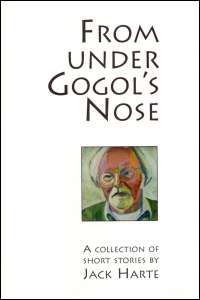
From Under Gogol's Nose
Published by Scotus
Press, 2004.
Available online from Scotus Press
www.scotuspress.com
Also available for Kindle from:
Amazon.com | Amazon.co.uk | Amazon.co.uk | Amazon.de | Amazon.de | Amazon.it | Amazon.it | Amazon.fr | Amazon.fr | Amazon.es | Amazon.es
Paul Durcan once aptly described Jack Harte's stories
as 'at once pure symbolism and pure realism'. This selection of stories
demonstrates Harte's extraordinary versatility as he himself sets out to
explore the possibilities of the form. In the prefatory section, his
'Storyman' rejects definition of the form, declaring, 'a short story is a
short story. Let's see what it can do. Let's see what we can do with it.
Let it sprout wings and fly. Let it veer deliriously from one extreme to
another. Let it skim so close to the discursive essay that it almost, but
not quite, becomes one. Let it veer so close to the poem that it is
preserved from absorption only by its narrative soul.' The ensuing stories
are written in the spirit of this declaration.
Read some of the reviews of
From Under Gogol's Nose online:
From the reviews
of From Under Gogol's Nose
Harte is a genuine master, moving from tales that recall Aesop and
La Fontaine to the Latin American surrealists. While asking us to “eat
the fruit of the tree of imagination”, Harte demonstrates how the story
may reach into the deepest fortresses of the human soul. Here is an
Ancient Mariner taking the reader by the ear and leading him into
strange territories where he suddenly recognises himself and is
astounded. We are all called to be witnesses – to love, pain, the
horrors of war, the failure of the imagination.
There are stories
here that are set to be classics, like ‘Murphy in the Underworld’,
‘Queen B’, and ‘A Message to Sparta’, and there are stories whose
lyrical pitch and rhythm approach the condition of song, such as
‘Turfman’ and ‘Birds’. An essential collection for anyone still touched
by the Irish short story.
Marvellous opening material on the state of the short story in
prospect and retrospect …. Wonderful stuff.
Jack Harte has been delighting readers for a couple of decades with
his unique brand of symbolism and mischief. His imagination is wild, but
tethered in a taut diction to give it credibility. A story that begins
with the words, “It came as a pleasant surprise to Murphy to find that
he could leave Hades at all,” could be deemed to be sailing very close
to wind, but he pulls it off.
Harte’s stories in their matter-of-fact referencing of the
preternatural and supernatural, and in their blending of the fantastic
and the mundane may be seen as affiliates of Magic Realism. However,
Harte instinctively resists definition and its concomitant limitation.
In an entirely entertaining and provocative prefatory piece, ‘The
Storyman Interview’, Harte speaks of the straitjacket of Cork Realism on
Irish story writing …. His use of language is inventive, and often
startlingly illuminating of an individual character or situation.
If you do one thing this week - Ponder ‘Painter’, one of the short
stories in the excellent collection, entitled ‘From Under Gogol’s Nose’,
by Jack Harte, the inspirational founder of the Irish Writers’ Centre.
In ‘Birds’, a unique adaptation of the myth of Mad Sweeney, Harte is
at his most iconoclastic, investing the yarn with poetic form. Fearless
artificer. Forever pushing the boundaries. In his blending of the magic
of myth with realism he has fashioned a fiction that is truly magical.
Sound plotting, cracking dialogue, and credible characterisations do the
rest.
Each story is a powerful evocative voyage which forces the reader to
contemplate his/her unique response.
Harte is an excellent storyteller. His stories are wonderfully
varied. Deep emotion, wisdom, and irony, all feature strongly. ‘A
Message to Sparta’ is as eloquent an expression of opposition to war as
you’ll find. …. ‘Gelding’ opens with “You asked me whether sexuality is
a bridge or a barrier between men and women.” The story that follows is
truly shocking. This collection will make new converts to the genre.
The form is so near the poem that it revitalises not only the prose
form, but also the narrative poem format, indeed fusing the two until it
could be either. The modern themes complement the ancient truths
explored, thus enhancing the reader's enjoyment … In this work Harte
explores the possibilities of the short story form with more confidence
and more success than most living writers. It is still the hardest form
to conquer, but Harte is clearly a master of it.
- The Black Mountain Review
In the introductory Preface section Harte teases out the short story
form, stressing that he believes in the infinite possibility of the
form. He expects the short story to challenge his imagination and to
savour the sense of wonder with the tools that every good writer
employs: subtlety of language, psychological insight, sharp
characterization, novel plots, a sense of symbol, and a mystery that
yields itself up to clearer definition only through exploration and
effort. Harte sets himself a demanding headline but he achieves it with
disarming ease.
...back to
Publications
|